Friday, August 5, 2011

Camp Hope


Most of my blog entries have summed up periods of time spent in Cape Town with explanations of the various activities i've been engaged in.  This one however will focus on only 2 days of the last 5 months i've been here.  Why? Because those two days happen to be the most influential, amazing, inspiring, and intense two days i've spent here.  For those of you who know me, you know that I have a deep love and passion for camp.  Day camps, over night camps, wilderness camps you name it, i've probably been a part of it at some stage in life.  I dont know if it is the community atmosphere, the way kids respond to camp activities, the songs that are always sung in unison, or that it brings me back to my youthful days. Anyways, this weekend I had the opportunity to volunteer for a camp in Noordhoek, outside Cape Town, called Camp Hope.

Camp Hope was started by a Rotarian and suggested to me by a friend who is also another Rotary Ambassadorial Scholar.  The camp is funded by the Rainbow Dreams Trust and is tailored to kids with physical and mental disabilities.  This camp was for children who are partially sighted or fully blind.
I've noticed that camps tailored to children with disabilities or diseases often have names with slightly exaggerated and often cheesy spins, but in this case Camp Hope was deserving of it's title. In only three days I saw transformation in not only the campers but the buddies (volunteers) as well. It was extremely powerful.

Going into the weekend I was told that I would be working with a woman who had been blinded at 18, only two years ago, and has had to readjust her entire life.  She wants to be an accountant, and must relearn everything in order to matriculate (graduate) and also become an expert in brail. I was nervous as I had no idea what to expect.  Putting myself in her situation, I think I would be quite frustrated, reserved, and may not enjoy a camp.  It turns out, she is an extremely powerful and inspiring woman.  She has definitely made the best of her situation, and I enjoyed every minute I got to spend with her.  The activities she accomplished in the weekend alone were inspiring.  She fearlessly tackled challenges such as rock climbing, goal ball (a variation of soccer for the blind), beading, relay races, tug of war, etc.  The best part of the weekend though was seeing her bond with other campers her age with similar challenges.  By the end of the weekend she had such amazing team spirit, it was wonderful to see her enjoying herself.

Another part of the weekend that was defining for me was dinner on Saturday night, not because I was starving by the time the braai was finished, but because everyone had to eat their food blindfolded.  This gesture of course was to honor our buddies and feel what it is like to be in their shoes for a little while.  I found it to be quite humbling, and what I remember the most was the conversation that arose from the activity.  Being blindfolded quieted me down as I focused on finding my food that I had deliberately split up into sections.  My buddy couldn't divide her food into sections, I thought.  I then searched the table for my drink, and decided it wasn't worth it.  I would have to eat my food without water.  Once I got a bit more comfortable, I began listening to everyone around me.  Everyone who was not used to such a disheartening feeling struggled to enjoy their meal.  Though it was funny to hear the other volunteers spit tomatoes out, or pass their cup a direction in hopes of getting juice; I know it struck a cord in all of us.  Not only did I get a small taste of what some of these campers experience on a daily basis, I was able to open conversation with my buddy about it.  Firstly, I heard another camper say "what does it feel like to be me for a change" with an upbeat tone of voice, knowing that we had no idea what we were getting ourselves into.  My camper however began discussing how frustrating it can be, but how you take it each day at a time.  There were so many things I wondered about like how it feels to have to rely on other people all the time, what happens if you end up alone somewhere how do you know who to trust, how do you manage on your own in your house, etc.  Some of the questions she kindly answered, and others I kept to myself not wanting to overwhelm her.  All in all, it was a lesson for me on her strength despite her misfortune and what an amazing person she is.

There are moments of every camp where I remember why I feel so connected to it.  Strangely enough, when I think back through most of my camp memories they mostly have to do with music.  In this case, I was able to witness a fantastic musical camp moment.  For the talent show, one of the women in our group (fully blind from birth) came up with a very catchy tune about her time at the camp.  She then played a few chords on piano to match it.  A few minutes later, our group had written an entire song about Camp Hope.  At the end of camp, we all got together and sang the new campe hope song, written by our camper. It was powerful. Something about this moment, made everything else disappear and I felt nothing but pure bliss.

For a split second I think we were able to make kids and adults who are faced with adversity feel normal, and that is a powerful thing.  I recognize that a weekend at camp doesn't change their situation, and each of them will have struggles with their disabilities that we cannot imagine.  But, there will be times when they can look back at camp and remember what they accomplished, the people they met, and what it felt like to have that community of support and hopefully they will feel lighter. even for a second..

Friday, June 17, 2011

The Fall in Review


Sorry folks for the two month delay! This post will be a summary of what i've been doing, and some of the things i've learned.  The past few months have felt like a whirlwind of Rotary speeches, homework, and out of town visitors.  It is basically winter here now so the weather has changed a bit and brought the rain and chill.  It is amazing how the grey days can change how I feel about the city or be the perfect compliment to drinking tea and watching movies. The sunny days, though they are fewer and farther between now, always remind me what a beautiful place it is here.

Classwork, Research, and Field Trips!: Classes picked up the last month or so, so I've been researching and turning in assignments.  I have also been working on finding topics for my research.  At the moment, I am looking to work in Imizama Yethu, a township in Hout Bay that is experiencing sanitation issues and hence having issues with water quality.  Other possible projects include working with this livestock farming community, assessing the amount of plastic waste in the creek beds in town, or exploring how townships decrease vulnerability to stormwater and flooding. I haven't figured out specifics, as i'm trying to find a niche within this topic that interests me, but those are some ideas at the moment.  I had the pleasure of going on a field trip for class to the West Coast National Park.  We learned about the issues facing Langabaan lagoon traditional fishers.  The fishers have struggled to maintain their livelihood in the face of a Marine Protected area that prohibits them from fishing in a part of the estuary they have always had access to.  We were able to meet with fishers, and National Park guides to hear both sides of the debate.  IT was a good hands on example of how science needs to be integrated into social sciences.  I am incredibly interested in this interface between science and society and greatly enjoyed getting to see it hands on in a local community.  The place we stayed wasn't too bad either!  We got to stay in a community based project called Duinepos which is a nice cabin style accommodation in the park.  We had a nice braai as a class and got to experience the bush for a night.  We also saw different types of buck and some ostrich, which are always a blast to see.

Rotary Talks:  The past month has been filled with Rotary speeches and meeting different Rotary clubs.  It began with the District Conference presentation which I had a part in planning.  Our task was to present to Rotarians from across the district about who the scholars are, where we are from, and what we are doing here in South Africa.  Our presentation went really well, and exposed me to various Rotary clubs across the country.  Since then I have been invited to clubs and have greatly enjoyed meeting Rotarians.  The opportunity to meet with different clubs has provided me with a great list of contacts for social activities, environmental work, and possible contacts for my thesis work.  All in all it has been a great networking opportunity.

A Piece of Home:  A few weeks ago I had the pleasure of a visit from my college roommate Bonnie and her friend Phillip from West Virginia.  I was able to do some touristy things like wine tasting in Stellenbosch, fish and chips in Hout Bay, drive to Chapman's peak and shopping in Green Market Square (a local market in town).  I was able to take them to a Rotary Club in Paarl and visit a township outside Stellenbosch where Bonnie used to volunteer.  On our way back from Stellenbosch (thanks to modern technology and the lack of real maps in the car I borrowed) we managed to get incredibly lost along a dangerous area at night.  (parents and friends, no need to freak out) This story is all to say that our friend Phillip stayed relaxed the entire time, while bonnie got extremely quiet and I began to freak out.  I was confused that he didn't immediately understand the kind of trouble we could have been in.  I realized later that the extreme wealth discrepancy can be avoided if you stay in certain areas of Cape Town, and therefore it is easy to not see the crime levels and extreme poverty that exist here.  It is hard to explain the complexities and divides of living in Cape Town, and perhaps as I reflect on it more I will be able to describe it in a future blog post.  But, I continue to be in love with the city, and intrigued by these aspects as well.

Speaking of crime, my Rotary Club of Roggebaai hosted a local writer by the name of Andrew Brown.  His book, Street Blues, addresses the complexities of crime here in Cape Town that he has faced as a police man in the Reserves.  He read a portion of a story he had written regarding his experiences responding to calls in various parts of Cape Town, and one township in particular.  He was discussing the ambiguity of police work here, and how he struggles to remain neutral and not recognize the humanity in others.  He spoke about getting to confront criminals and realizing that all of them are human.  Part of his story described an interaction he had with a child in a township that reminded him of the struggles of being a policeman, and the difficulty of having to judge a situation in the moment.

In other news, it is possible that I will be working with UCT to develop a solidified Service Learning structure so that more students are encouraged to participate in service learning and those that do receive credit for it.  At this point it was just a friendly request from my professor who is on the social responsiveness committee, but could be an interest project to take on.  I am also hoping to get to work with outdoor education in some schools with an environmental education non-profit.  In July my roommate and I are looking at traveling with some other scholars and friends in Botswana and Namibia.  I hope to get to spend more time exploring other parts of the country as well as doing fun cultural activities around Cape Town.

Friday, April 1, 2011

A Few New Perspectives


Last week I was able to have new experiences of Cape Town, giving me different perspectives of the city.  I visited a few of the townships during a tour of a non-profit, road in the mini taxes, went to the Old Biscuit Mill local market, volunteered at the Cape Argus cycle tour, engaged in interesting class discussions, and had a nice dinner with my host family.  Below are the details of my last few weeks, and reflections on what I have had the pleasure of seeing.


ABALIMI BEZEKHAYA:  "Farmers of Home" is a non-profit organization that I stumbled upon via my Rotary Host (thanks Terrence).  The organization has been established for almost 30 years with the goal to alleviate hunger in low-income communities through sustainable and organic micro-farming initiatives.  Abalimi means "the planter" in Xhosa, which is the main language in the communities that the organization targets.  The farmers involved in Abalimi have traditionally been the elderly women of the community who are taught how to create and maintain gardens that will sustain them throughout the seasons and provide nutrition for their families.  These women then hold workshops to teach other women throughout the townships how to create their own small plots.  I spent the morning on Tuesday touring the large community plots, the training facility, and the Harvest for Hope shed (where the vegetables are brought to distribute to the community).  It was a fascinating morning where I had the pleasure of meeting some of the head farmers in Nyanga  and Phillipi (two townships outside of Cape Town).  For those who are unfamiliar with this term, townships are low-income communities formed under apartheid government and therefore are primarily black communities.  I was incredibly impressed by the organization for several reasons.  Not only were the gardens large plots of land on previously abandoned waste land, but the director of the organization refuses to sell the vegetables produced to any individual or company who does not believe in the principals behind the organization.  If you'd like to know more about the non-profit, you can check out the website: http://www.abalimi.org.za/.  The part of the project that i'm currently getting involved in is Harvest for Hope.  I help pack boxes every week that are sold to people around the Southern Suburbs at various schools.  The manager of the non-profit makes sure that all of the community members that buy the vegetables in the Harvest for Hope boxes understand where the food comes from and why it is important to buy locally.  It is a fascinating organization and I look forward to telling many more stories. 


UNDERSTANDING A NEW CULTURE OF SERVICE: In addition to seeing the projects Abalimi runs, I was able to have a variety of conversations that helped me understand the culture of service in Cape Town a bit more.  When I first met the head female farmer in Nyanga, she shook my hand and asked me where I was from.  I responded explaining I was from the states and would like to volunteer.  She took my shoulder and said "you must date a white man, and bring him here with you to volunteer".  Later, I asked the women who drove me back to my apartment why this comment would have been made.  They explained that most people that volunteer here are foreigners, and South Africans at my age are not pushed to volunteer.  It made me think about all of the systems in place in the U.S. that help promote our age group to volunteer for our communities.  I realized how many various factors are involved with the service movement, and it changed my perspective from one of frustration to appreciation for the opportunities we are given in the states.  It did however lead me to question Is volunteering linked to wealth and comfort? or Has the U.S. just included it in the system to a degree that provides more opportunities for young people to volunteer than in South Africa?  Though the culture of volunteering is stronger for National residents in the States compared to here, I think the interconnectedness of the organizations in South Africa is something to look at.  In conversation with various professionals in the service field at dinner one evening, I started to really consider how non-profits function here and network.  On the whole, it feels much more like a giant network where everyone shares information and works together with less structure and hierarchical organization than many of the non-profits in the states.  This seems to work very well here and provide strong relationships among organizations and in turn greater support for community members.


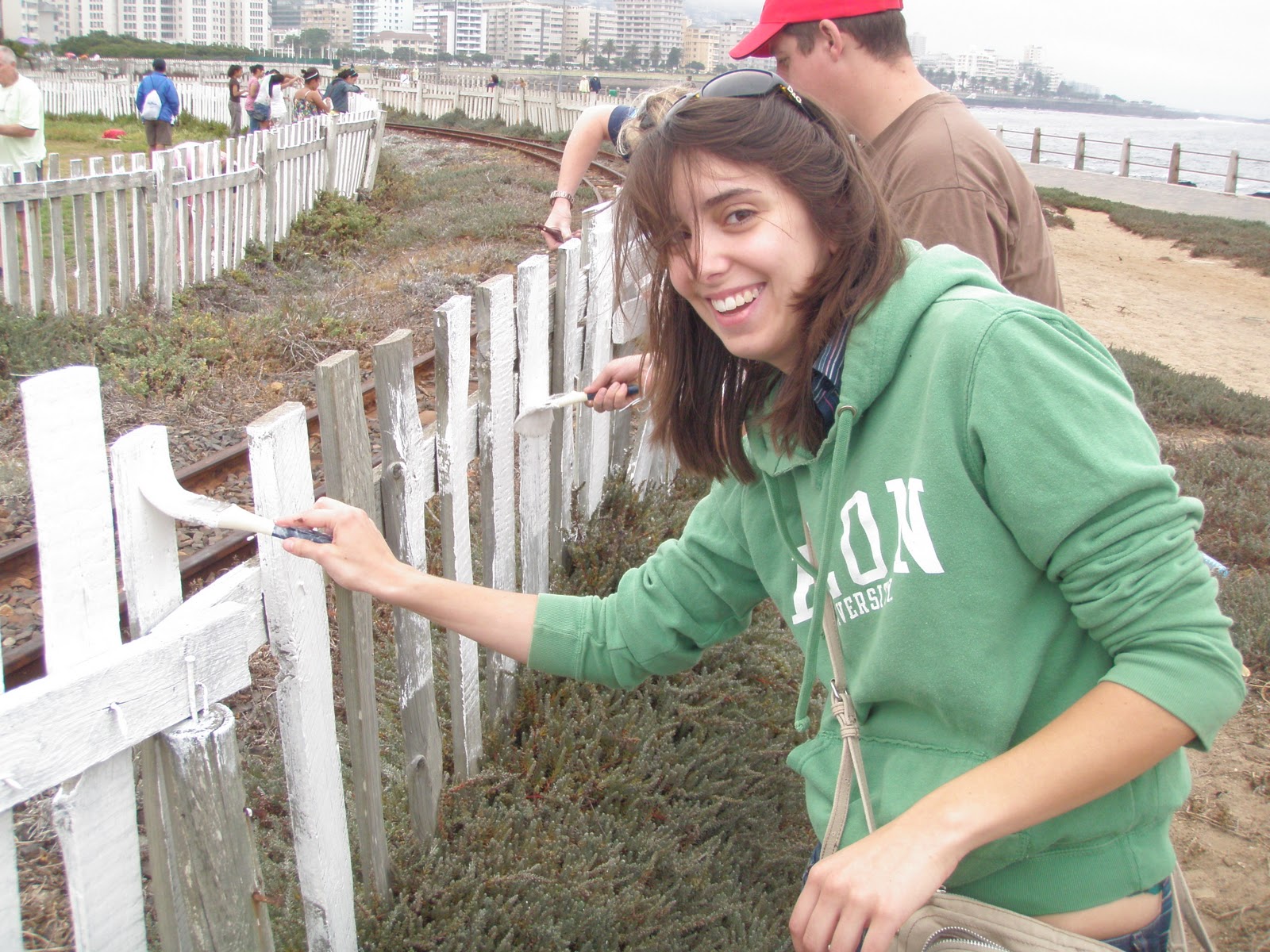
TYPICAL SOUTH AFRICAN SATURDAY:  On the lighter end of things, I have been able to see and do a variety of wonderful activities in and outside of Cape Town.  Two Saturdays ago I had the pleasure of spending the morning / afternoon participating in "typical South African" traditions, some specific to Cape Town.  It started with a Jammie Ride to UCT where I was picked up by some friends.  Then, we jumped in a mini-tax, my first mini-taxi experience, and headed to Woodstock.  For those of you that aren't familiar, mini-taxes are inexpensive, taxi-vans that take people to various parts of the city.  They do not have the safest reputation, but they are accessible and inexpensive.  At Woodstock we went to the Old Biscuit Mill which is this large market with all sorts of food.  There were all kinds of different people there and so much to eat!  I had a routi (typical South AFrican meal).  A Routi is a type of curry wrapped in a warm tortilla, and it is delicious!  We then grabbed dessert and headed to the waterfront (again via mini-taxi) where we ate our dessert on a boat ride around the harbor.  It was a fantastic afternoon with very cool people who were extremely excited to share all of these South AFrican traditions with me.  The next morning I volunteered for the Argus Cycle tour which is a famous bicycle tour around the Cape Argus.  I met a lot of different people, and saw the cyclists off on their 100K journey.  The following weekend I attended an all day concert with local South African artists where I could hear a lot of the music i've been listening to since my last visit.  I also participated in a Rotary Event with the Seapoint Rotary club painting a fence around a park.  It was a very nice community event with lots of kids, families, and people from all different walks of life.

For the weekend I went to Hermanus, which is about an hour along the coast (worth googling) for part of my vacation from university.  I spent the weekend relaxing, walking along the coast and even got to Sea Kayaking!  I had an awesome seafood lunch at Beintang's Cave which is a restaurant right along the coast. 


Yesterday, I went back to Robben Island where Nelson Mandela was in prison during Apartheid.  I had been before in 2008 during a history and culture course and had the pleasure of returning with some friends who were visiting from the states.  It is a very intense place to visit, thinking about all of the inequalities and torture during Apartheid government let alone hearing it from a past prisoner.  It is indescribable the way this country has turned out after such a torrential time for most of it's people.  Yet, the past is the past and you can see that it is behind them.  It is fascinating learning about all of the leaders that were able to make the end of apartheid so peaceful.


Sunday, March 6, 2011

Laying the Ground Work


Two weekends ago I had the pleasure of spending the weekend at my friend's holiday house in Kleinmond, which is on the coast southeast of Cape Town. We spent the weekend braai-ing, hanging out on the beach, playing guitar and catching up. It was a nice weekend outside of Cape Town and I had the chance to explore a different part of the Western Cape. The scenery was absolutely beautiful. I've included pictures above of the scenery there and along the drive. The beauty of South Africa has not ceased to amaze me.


THE LEAP SCHOOL: My next project has been finding a service site as well as a possible sister school to do an exchange with my high school from Atlanta. I believe I mentioned in my blogs earlier that I had met a teacher from a school called LEAP. LEAP is a high school for students from low income areas where the focus is on Math and Sciences. In addition to classes, they have a life orientations course which provides time for each grade to get together and talk about issues relevant to their age. For example, the grade 12 students are working on college applications, CV's, and job applications. Each LEAP school also focuses on giving back to the communities in which the students come from. Therefore, there are two service projects per semester that the school participates in. Everyone at LEAP was extremely welcoming to Jessica and I. We were able to see every class in action, get a school tour, meet the principal of one of the schools, and sit down with the volunteer coordinator. They were eager to see how our service could focus on working at LEAP. The Principal wants to focus more on how students can understand their role in community service as well as increasing global understanding and community. It was definitely a good start for figuring out how I could make my time here count. As of right now though, i'm still working on building relationships with organizations and seeing which one will fit my skill set. I hope to meet with teachers at the LEAP school again soon and see if I might be able to help out in the classroom and with planning service projects.


END POLIO NOW: One event that I had the pleasure of getting involved in through Rotary was planning Rotary International's Birthday on 23 of February. Each year on Rotary's birthday, district's around the world plan an "End Polio Now" screening on historical buildings. This year South Africa used the Cape Town Stadium to show their support for ending polio. Because
Polio only exists in 4 countries, and 1 of them is in the district, raising awareness is a huge part of the focus in this district. The other huge campaign that my District here was involved in was "kick polio out of Africa". This campaign sent a soccer ball around Africa gathering signatures and raising money to support the distribution of polio vaccines in Angola and Nigeria. In order to celebrate all of these efforts, the district plans the lighting every year so Rotarians around the world can see the "End Polio Now" lit up on the Cape Town Stadium. The event was small and consisted mostly of Rotary members but it was a nice way to celebrate Rotary's Birthday.

HEALTH CARE: This past week i've become a bit more acquainted with the health care system here. Unfortunately, it came at the expense of my tonsils. I came down with tonsillitis last week, and luckily had a friend with a car take me to a Medi Clinic (like an Urgent Care in the states). Transportation, or lack there of, proves to be a setback in situations like this. Thankfully the people i've met here were extremely supportive and helped nurse me back to good health. Anyways, I had the pleasure of going to a Medi Clinic. It proved to be a very pleasant experience, though later I was told it is an upper / middle class hospital. The reason I mention this is that I walked in without my ID and with just my international insurance card. In turns out, here you can get any sort of medical care - a private doctor or at help urgent care centers - without having an ID and /or health insurance on you. I found this to be quite convenient, and realized that there is a bit more red tape when it comes to getting care at most places in the U.S. I also realized that in the states I never really had to worry about it, which got me thinking about what health care is accessible to those without insurance and how much it costs.


TYPICAL DAY TO DAY: In general, i've been working on settling in and finding my routine here. It's easy to forget i'm not in America, but there are always the little things that remind
me. For example, I'm getting used to hanging my clothes up on the clothes line instead of using a dryer, having the internet cut out every few minutes, watching rugby and cricket, buying electricity and cell phone air time, and relying on the mountain breeze to keep me cool during the afternoon instead of air conditioning. It's strange how many things come so easily in America that you don't even think about until they are inaccessible. It has been an adjustment working all of these things into my new daily routines, but it's all part of the exciting experience of being somewhere new. Living in Cape Town has a lot of perks. I spend a lot of my free time going to the beach, going to braai's with friends, and traveling around to various areas of the cape. I attend my Rotary club meetings every few weeks where I get to catch up with various Rotarians. This week i'll have the opportunity to check out another non-profit that builds gardens in townships. So, my goal here is to keep living in the moment, taking advantage of opportunities, and enjoying the people I meet along the way.